
Headline News
Habitat for Humanity launches tiny homes on the consumer market
May 14, 2026 · 2 Comments
By Joshua Drakes, Local Journalism Initiative Reporter
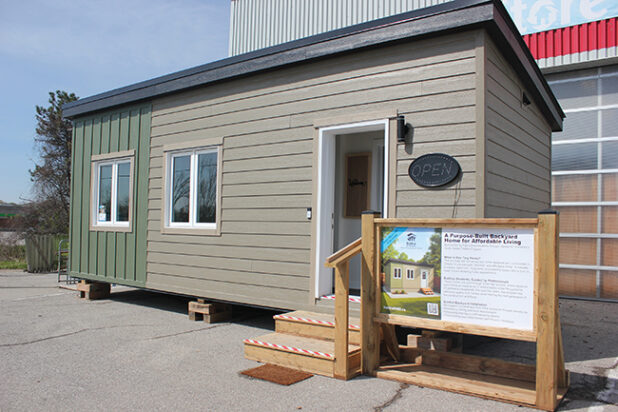
Habitat for Humanity is displaying one of its tiny homes at the Orangeville ReStore to promote its new availability for purchase.
Habitat for Humanity’s tiny home program is emerging as a practical response to housing pressures in Ontario, offering compact, fully self-contained units designed for both social need and private use.
Peter Oliveira, an engineer with Habitat for Humanity, said the program started as a unique project for small First Nations communities that needed practical housing options.
“It started just with a pilot where First Nation communities expressed interest in receiving tiny homes,” he said. “They were trying to look at adding to their housing capacity by allowing or providing more individual housing. That’s how we got started, with an original agreement to build five tiny homes with First Nations. Now, all of those homes are being occupied.”
Each tiny home is built to Ontario Building Code standards as a four-season dwelling, with a full bathroom, kitchen, and a flexible living-sleeping area, totalling roughly 250 square feet.
The units are intended for single occupants and are being used or considered for multi-generational living, backyard rentals, youth housing, and small-scale business or office space.
These units are now available for private homeowners, and Habitat for Humanity now offers backyard installations.
“We’ve been doing the sales approach now since last summer, so it’s still relatively new to us, because historically, all these tiny homes have gone to First Nation communities,” Oliveira said. “Most of the interest we’ve gotten is for multi generational living. Our first backyard build is actually for a 20 year old that’s going to be moving to the backyard so that they have their own little space, and then the in-laws that need more care are going to be living inside the primary property.”
The tiny homes are highly modular, offering a universal frame but a customizable interior to fit the needs of the person who will be staying there. The building doesn’t even need to be necessarily for living, as configurations can be made for an office or workspace.
“We’ve also had a lot of conversations with homeowners that are interested in using it for business space or office space as well,” Oliveira said. “We can take the kitchen out, for example, and then they have a massive office. They can also use it for gym space.”
“We’re open to working with homeowners on those kinds of options, but overall, the layout essentially stays the same with every build. It would just be a matter of removing cabinetry, changing paint colors, and changing floor colors.”
Habitat also directly supports homeowners through zoning checks, building permits, and site assessments, identifying factors such as conservation areas, flood zones, and utility tie-ins before construction proceeds.
Once permits are approved, on-site work typically takes about a month. The completed unit arrives largely finished, with appliances, cabinetry, and interior finishes in place. The tiny home is then craned onto a prepared foundation and connected to services, minimizing disruption to the property.
Behind each home is another factor, as well – an education-focused construction process that doubles as a training platform for high school students interested in the trades. The build runs over two school semesters.
Students get to help assemble these homes as part of an educational and experience-based program with Habitat for Humanity.
“Students work on them from sticks on the ground,” Oliveira said. “Typically, our build period is from September until June. What that allows us to do is work with students over two school semesters.”
In the first term, senior students handle structural work, including framing, subfloors, walls, and roofing, while earning key safety and workplace certifications. In the second term, a new cohort completes siding, flooring, trim, cabinetry, and painting. High-risk tasks, including electrical, plumbing, mechanical systems, roofing finishes, and exterior caulking, are completed by licensed professionals.
The extended, roughly 10-month build window allows for careful inspections at each stage, with errors corrected as part of the learning process rather than rushed to meet a deadline.
“It’s also important, as a teaching tool, not to rush,” Oliveira said. “We’re not trying to push the speed of construction… Really, the home is kind of like a byproduct of the program that we really care about.”
Now on display at the Orangeville ReStore, the tiny home is a true collaboration, offering students valuable skilled trades experience and sturdy homes for those in need.
For buyers, the tiny home offers residents a chance to see firsthand how compact design, flexible use, and community-focused construction can come together to address evolving housing needs. Those interested are encouraged to see the tiny home in person while it sits on display at the Orangeville ReStore through spring and summer.
Readers Comments (2)

I personally had a scaled version tiny home created by a local contractor with quotes for $10-$12k. The estimate, contractor details, potential locations and model were brought to Orangeville HomelessnessTask Force meeting in Spring of 2024.
I was thanked for my initiative as well as my sharing lived experiences with homelessness as it was also reported on by Ms Weston
The Homelessness Task Force transferred its query and future homelessness efforts to the County of Dufferin as a larger issue.
Orangeville is seemingly between the advocated growth needed to support its constituents as a city, however it cannot be done by maintaining the coveted small town feel.
There’s a crisis in housing consistent with the country. Very large contributions have been made toward a public maintenance of homeless and those within a flat tire or missed paycheque of becoming so. I am to understand that this may now be up to individual citizens to help house those who require this modesty. With similar funding that has been provided to Choices and repeated reports of its financial insecurity and need to constantly top up from this community….maybe take that half mil, fund the installation of a small community of possibly 50.
Many many small and major cities have implemented these processes without issue and immediate impact. May not be THE answer to this crisis, but surely destroying tent encampments is not the only way to move people from public eye…we could just work a whole lot more efficiently to house them…sorry…us. House US!
dishes