Arts and Entertainment » Headline News
Baskerville brings mystery, mayhem and laughter to Theatre Orangeville: Review
September 3, 2026 · 0 Comments
By Joshua Drakes, Local Journalism Initiative Reporter
Theatre Orangeville’s production of Ken Ludwig’s Baskerville: A Sherlock Holmes Mystery delivers a fun, fast-paced, clever and wonderfully chaotic theatrical experience that combines mystery, comedy and beautiful set design.
Based loosely on Arthur Conan Doyle’s The Hound of the Baskervilles, the production follows Sherlock Holmes and Dr. Watson as they attempt to unravel the mysterious deaths surrounding the Baskerville family.
But this is far from a traditional Sherlock Holmes adaptation. The story moves at a breakneck pace, with humour, physical comedy, disguises, accents and unexpected characters constantly keeping the audience engaged.
One of the production’s greatest strengths is its cast.
The actors display remarkable comic timing and an impressive ability to shift between characters at remarkable speed. With the ensemble taking on more than 40 roles, the sheer number of characters could easily become confusing, but instead it becomes one of the show’s biggest sources of entertainment.
Despite being a Sherlock Holmes story, the real star of this production for me was Dr. Watson.
Watson quickly became my favourite character. More than once, Watson seemed very much aware of the absurdity of the situation and humorously said so, though it didn’t do much good in the moment.
Seeing Watson take on the lead role of the story as the production continued was an unexpected joy, as the actress behind the character was clearly having a lot of fun, which made the production all the more enjoyable.
That’s not to say the rest of the cast didn’t do the same. Seeing Young Company put on such a well-planned, well-executed production was a pleasure.
For Young Company, the level of control and confidence was particularly impressive, and they handled a complicated and fast-paced production with commendable grace. They were fast to switch characters, and each character felt unique, different and one of a kind. I didn’t ever feel I was watching one actor playing the same two or three characters. I believed they were different people and I could follow the transition on stage without any issue.
Watching an actor transform from one personality into another – often with a completely different voice, physicality or attitude – is a theatrical feat in itself. The performances are quick-witted, energetic and committed, with even the smallest moments often finding a laugh. Seeing it all done by a youth-centred theatre company only demonstrates the tireless practice that went into this production, because it showed on stage.
The stage design deserves particular praise as well.
The production makes excellent use of theatrical effects, sound, lighting, smoke and movement to create a sense that the entire world of the story is constantly shifting around the actors. There is something especially satisfying about watching the mechanics of theatre become part of the entertainment.
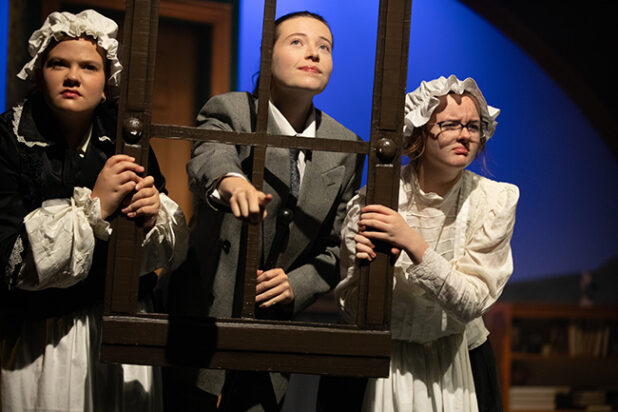
The Baskerville Manor was, in fact, a tiny model house on a hill for most of the play. When inside the building, actors physically held up windows for the cast to look through, which the audience accepted openly with laughter.
Despite how simple many designs were, they were used so effectively it didn’t really matter to the audience. With three props on stage, you’re in London. Another three, you’re across the country, travelling to meet the Baskervilles.
Windows, candles and doors were all that was required to sell the illusion, and it worked. I could believe I was travelling from location to location, with only handheld props moving across the stage. It was an excellent use of perspective and minimalism.
Then there is the humour. Baskerville never takes itself too seriously, and that is precisely its charm.
The jokes come quickly, the physical comedy is wonderfully exaggerated, and the production has a playful awareness of its own theatrical absurdity. Rather than simply telling a Sherlock Holmes story, it invites the audience to enjoy the process of watching one being created.
The big fear of the story is a mythical hound that supposedly picks off victims left and right. How did the cast respond? Sir Henry Baskerville wanted to grab his gun and set off to shoot it, cowboy hat in hand.
Those sudden breaks in tension helped carry the story forward with a lighter, more humorous tone that still conveyed the story’s seriousness.
The areas for improvement are relatively minor. On some occasions, with music or sound effects, the voices of the cast are difficult to hear or understand. Lowering the volume of the music and sound effects would occasionally help the actors’ dialogue come through more clearly.
Ultimately, Theatre Orangeville’s Baskerville is a celebration of live theatre: inventive, energetic, funny and full of theatrical surprises.
With its stakes, tension, laughs and inventive theatricality, Baskerville is a perfect example of how dynamic Theatre Orangeville’s Young Companies can be – and just how far a talented young ensemble can take a production.
Readers Comments (0)