Archive
Orangeville Food Bank holds hunger awareness event for municipal candidates
October 13, 2022 · 0 Comments
By Sam Odrowski
Candidates in the upcoming municipal election from across Dufferin County recently had an opportunity to learn about food insecurity, the work of the local bank, and how they can help, if elected.
The Orangeville Food Bank invited candidates to a hunger awareness event on Tuesday (Oct. 11) evening, where they learned of the challenges people in the community face concerning transportation, poverty, and getting enough to eat.
Heather Hayes, executive director of the Orangeville Food Bank said she’s held similar events leading up to past elections as it’s important for municipal leaders to understand what the organization is all about, the wide range of people accessing it and the struggles it faces.
“I’m hoping they got a better understanding of who uses the food bank,” said Hayes, “It really is our friends, our families, our neighbours. And the services that we provide here, it would be great if nobody ever had to use a food bank but until that happens, we have to do the absolute best we can to ensure that people have the food they need.”
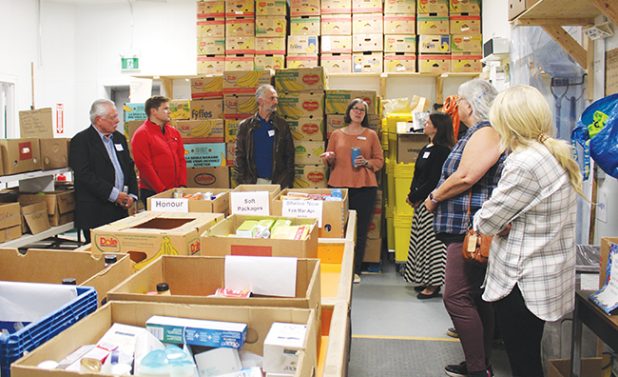
The event started with Hayes giving an overview of the food bank’s work. Candidates were then taken on a tour of their facility, located at 3 Commerce Rd., which was purchased and renovated in 2020.
During the tour Hayes shared that 75 per cent of all their donations come in from Sept. to Dec., carrying them through the rest of the year.
When she first started at the food bank in 2015 they saw around 300 people a month, whereas last month they saw 875. There’s been a 250 per cent increase in working families, who identify full-time wages as their primary income source, accessing the food bank.
The largest increase is in seniors over the last decade, which went from three in 2011 to 160 last month.
Hayes added that statistics show only 20 per cent of those who need their service will come through their doors, so the nearly 900 people who they supported last month is likely closer to 4,500.
Transit and stretching food exercise
Following the tour, attendees were broken up into two groups for an activity. One group was presented with a scenario where they had to navigate Orangeville’s transit system. They had to get from their rent geared apartment near Orange St. to Princess Elizabeth School for 8:30 a.m., get to the food bank afterwards for 10 a.m., then head to Walmart to get items they didn’t have at the food bank, before going to the hospital for an important appointment at 1 p.m. After the appointment, they had to get back to the school to pick up their kid before 3 p.m.
Candidates quickly learned this scenario is nearly impossible to complete under the current transit system and Hayes explained how it’s important when setting policy or developing programs to ensure it is looked at through the lens of those who need them the most, often those in poverty.
The other group had to figure out if they could get enough food for their family from the food bank to make two weeks’ worth of meals. Candidates tasked with this scenario also learned that it’s not feasible. They couldn’t stretch the food over two weeks.
Food Bank Q&A
After the group activity, Hayes did a Q&A with candidates.
Orangeville councillor candidate Peggy Bond asked if there is any criteria for accepting people into the food bank’s programs.
Hayes responded that as long as you walk, talk, live, and breathe, you are eligible. She noted while the food bank does collect income and expense information from those who access their services, it’s solely for statical purposes.
One person told Hayes they were self-employed, making $100,000 per year, but had five kids, two with extensive medical problems, so the mother couldn’t work as the kids were constantly in the hospital. They ended up having to claim bankruptcy, so Hayes noted that while someone may appear to be doing well on paper, that is not always the case.
She said most people have an idea in their mind of who accesses the food bank, but it’s often their friends, neighbours, and coworkers – the people who they’d least expect.
Hayes said she sometimes hears concerns of people “abusing the system” by accessing the food bank but in her eight years working at the local not-for-profit, she stressed that this is a myth.
And you manage by the general rule, the 99 per cent, you don’t manage for the exception that is the one per cent.
Tess Prendergast, Orangeville councillor candidate, asked Hayes what her biggest ask is of a future councillor or mayor.
She responded that there are a few different components but affordable housing is key,
When developers bring forward proposals, council needs to stipulate that a portion of the units are built as affordable – not $1,500 a month – but something truly accessible to those living in poverty.
The other ask from the Orangeville Food Bank is for a future council to provide financial support.
The organization has seen an unexpected 40 per cent increase in usage year of year, which their $114,000 budget hadn’t factored in. While the food bank was expecting an increase, it didn’t anticipate it would be so large. This rise in usage is expected to continue increasing as families spend more heating their homes and preparing for the holidays.
Hayes stressed that the food bank can’t take away the amount of food it already gives and their clients depend on.
Hayes also noted the importance of setting policies or programs that people with zero resources can access – eliminating barriers for those who are poor.
“The best thing you can do is start accessing services from their perspective, not yours,” she said.
Predatory payday loans are another area that a future council can help legislate against or provide alternatives to, said Hayes.
Currently, people get trapped paying anywhere from 60 to 600 per cent interest on certain loans, so they can get $100 early to cover essential costs.
“A lot of our clients need $100 but they’re cashing their paycheck early to get that $100 because there are no other options. They don’t have somebody to call for 100 bucks,” noted Hayes.
Creating a micro-financing credit system would be a solution. This could be a municipal program, providing small loans with a normal interest rate.
The final point Hayes made on what a future council can do is understand the mindset of people in poverty.
She said they are exposed to more than 50 per cent fewer words in their lifetime than someone who is middle class and significantly less than someone who is upper class. With a smaller vocabulary, they may be more likely to swear while accessing services, which could lead to them being cut off. Having some level of understanding goes a long way.
Those living in poverty also don’t generally have a future dream, Hayes said. They’re focused on getting through the day, not looking ahead to tomorrow because they don’t know if they’re making it to tomorrow.
Creating workshops and programs that help people in poverty become connected to resources, shift their mindset, and learn how to escape poverty as well as courses for government officials to understand the issues from their perspective is key, Hayes noted.
She told the Citizen she hopes all the candidates who came out learned a little bit more about how the system and will be better educated on how to support it going forward.
Readers Comments (0)